Showing posts with label ougd104. Show all posts

Tuesday, 20 April 2010

Visual Language

After collecting a range of images based upon light switches, I then took the idea of having pairs together, and began photographing them outside of college. Here are a few of my images:


Visual Language - Experimental images for Book Fair


Monday, 8 February 2010

Visual Language

Adjective (describing word)
''Brady is doing a silly dance''

Noun (naming word)
''Brady is doing a silly dance''

Verb (doing word)
''Brady is doing a dance''

Pro-noun (replaces the noun)
''We are dancing''

Objective Personal Pro-noun
Me/you/us/her/it/him
''Dance with me''

3rd person Objective Personal Pro-noun
One
''One would like some cheese''

In the First person
(singular) I
''I like cheese''
(plural) We
''We are dancing''

In the Second person
(singular) You
''You like cheese''
(plural) Us
''Dance with us''

In the Third person
(singular) He/she/it
''He likes cheese''
''She likes cheese''
''It is cheese''
(plural) They
''They are dancing''

Verb & frst person
(singular) I am
(plural) We are

Verb & second person
(singular) You are
(plural) You are

Verb & third person
(singular) She/he is
(plural) They are

Third person objective & Verb
One is

Visual Language

Using a book I brought in, I had to interpret the title of the book by cutting or folding the pages. My book was called 'Tackling Computer Projects', so I decided to create a laptop consisting of a monitor, keyboard and mouse. I thought this was a good idea as I could have the book open as you would have a laptop. I really liked some of the artists work that we were shown during the lesson and I will research into some of these artists.

Visual Language 3/11/09

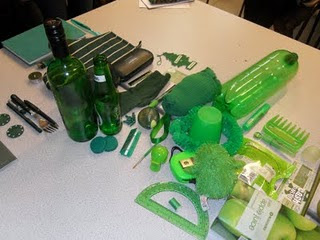
We had to bring in 10 items of a certain colour. Mine was green. Then we were allocated groups with the same colour. We then had to arrange our objects into some sort of order, that showed the range of the colour green. We did this depending on the hue, started from blue/greens, to true greens, to yellow/greens. This was quite hard as some objects had different tones and shades so we began to work outwards from lighter to darker.


We then had to chose 10 objects from our complete range, of a variety of different hues, that we could then use the pantone colour swatches to find out there correct pantone value. Some of the colours were hard to match up as they wer reflecting light.

Tuesday, 15 December 2009

Visual Language 8/12/09

In this weeks visual language we were sent out in groups of two, to collect 100 photos of a specific subject. Me and Niall had been given plug sockets. With it being quite a simple subject, I decided to try and make the images more interesting by including what the plugs sockets were being used for. I found these worked better than just the sockets alone, and I also considered the composition of my images. I particularly like the images that are close up in one point and then extend further away from you as more of their surroundings are being captured.
Here are my favourite 25 images:

Tuesday, 17 November 2009

Visual Language 10/11/09

As a group we all collected items of a certain colour, and aranged them in a circle by colour of hue. My colour was green, so I had to then choose a few green objects, and also objects from its complimentary colour (red).


Concentrating on which colours contrast and compliment eachother, I had to use the objects with coloured paper to experiment with and find different combinations.

Visual Language - 13/10/09

In todays session we had to create four different interpretations, in each 10x10cm square,using the letter A, that represented scale and frame. We then had to swop these with another person in the class and create three multiples of each of there interpretations, after figuring out what they were tying to do in each one, and seeing if we could improve on it.


The top row of four were the other persons, and all the ones below them are all my multiples of them.

Friday, 6 November 2009

Visual Language 20/10/09


The work we did in our visual language session reminded me of this work created by Bela Borsodi, by taking into consideration the depths of the plains.

Monday, 26 October 2009

Visual Language 06/10/09

We were given 5 words that we had to again interpret in our own way. But this time they each had to be of a set of four 10x10cm squares. We then had to create single 10x10cm frames of each word that simplified the sets of four.


Jumble
For the set of four they started as a perfect line of A's that were begining to rotate and eventually fall out of line and become jumbled together.
Then for the single frame I simply made this jumble effect smaller:


Hybrid
For the set of four I used two different typefaces coming from each opposite sides of the set of four, and then had them colliding together in the middle.
For the single frame I simplified this down and kept the idea of the two typefaces colliding together, but in a smaller form:


Extend
For the set of four the line of A's spread further away from eachother frome each frame to the next as if they are extend outwards.
The single frame is a smaller version of this as the line of A's become further apart from eachother:


Edit
In the set of four, the first consists of four Vertura A's, the second of three Vertura and one Helvetica, the third of two Vertura, one Helvetica and one Times New Roman, and the fourth of one Vertura, one Helvetica, one Times New Roman and one Gills Sans Ultra Bold. This is to show that as you look from one frame to the next you can see thta a letter has been 'edited' each time.
For the single frame I have made this idea smaller, and in each row you can see a change to one letter each time:


Deconstruct
In the set of four the first frame is a pyramid and as you look from each frame to the next, the letters are being taken away and deconstructed.
For the single frame I have tried to show this by showing the levels of the pyramid being taken apart:

Visual Language 29/09/10

We were given ten words that we had to create our own interpretations of, using only the letter A in a 10x10cm square. The ones I found the most effective were right-angle and enclosed, and the ones I found the least obvious were connect and finish. Below are my samples:


Break

Connect

Enclosed

Finish (Finishing Line)


Loop

Negative (Space)

Projection

Right-angle


Spine

Systematic